The Maschinenkanone (MK) 108 was a short barrel 30-millimeter cannon It was much more powerful than the MG/FF 20mm cannon. To put it into perspective a MG/FF 20mm cannon would need around 20 hits on a B-17, which the MK 108 cannon could do in four hits. Because of its immense power the MK 108 standard armament of most German fighters after 1943. The MK-108 had a fire of 650, but a very low muzzle velocity of 540 m/s. Because of this low rate of fire, the MK 108 was difficult to fire long distances. It was also very cheap for the Germans to produce.
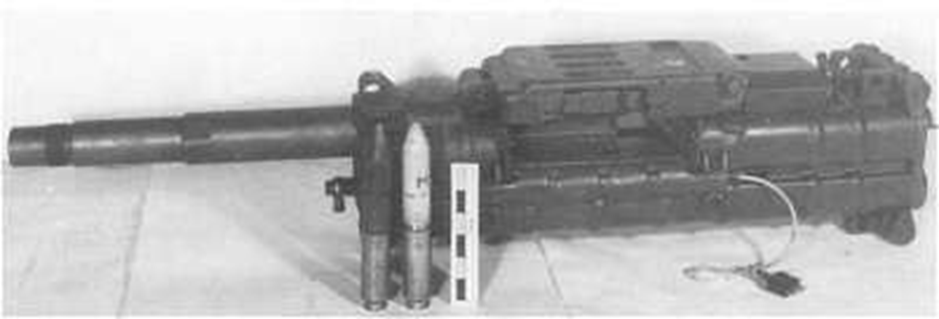
Early saucer craft like Vrils and Haunebus were armed with MK 108s, in order to supplement the energy based, with something that didn’t affect the crafts power usage. However, when these conventional weapons were used within these exotic crafts. Because of the way Haunebus and Vril crafts moved, they were unable to fire the MK 108 accurately. Energy weapons didn’t have this issue. They also fired at a much faster rate, and much more accurately, since they were just a beam of energy and not an object, cutting through the air ballistically. Despite this the MK 108 was still fitted on German saucers as a secondary defense mechanism. It was used with KSK for shorter range of engagements, while the crafts were moving. The KSK would be used for long-distance shots, when it was safe for the craft to stand still.
Another interesting feature with the MK-108 was how durable the ammunition was around certain temperatures. In space and on the moon, temperatures vary -280 to +250 degrees Fahrenheit. The ammo for the Mk-108 was able to stay stable at these temperatures, a 1947 report in the archives of Britain’s Ministry of Defense concluded. The blow back mechanism would need to be tuned to work in vacuum conditions, for the weapon to be fired in space.


Leave a Reply