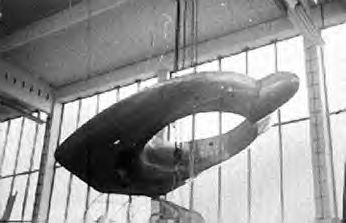
Heinrich Focke would also design a craft, known as a Fw-Rochen, which had a shape similar to a flying saucer.
It had a large fan, inside the body of the craft. The craft controlled itself by vectoring air downwards through a series of vectoring louvers, at the bottom of the craft. During flight the louvers could be completely closed, so the craft could operate using glide flight. The exhaust nozzle was placed at the rear of the craft. At lower speeds the craft would push air through these same exhaust nozzles to thrust the craft. For high-speed flight, these same nozzles had a chamber with a fuel line and ignition, which would act as an afterburner during the flight.
The landing gear simply consisted of two main landing gears on the side of the craft, and a small tail wheel. A single tail rudder and a set of ailerons and flaps for use in high-speed flight. A pilot would sit in a fuselage at the front of the aircraft.
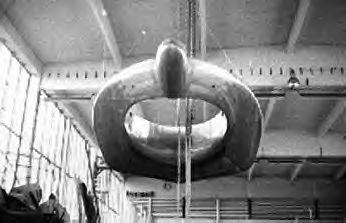
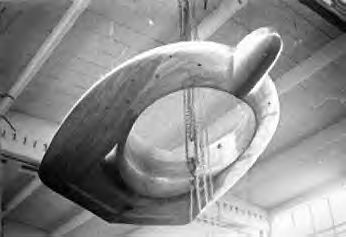
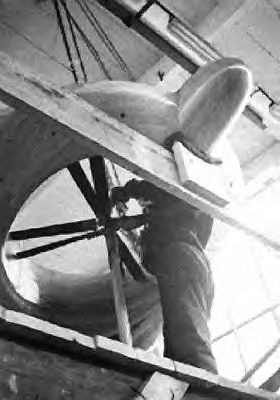
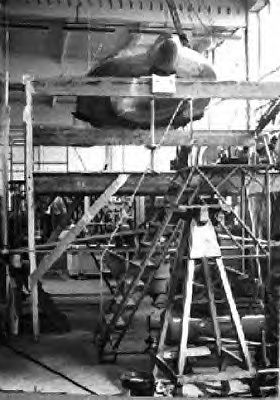
Unfortunately, the Focke-Wulf Schnellflugzeug Rochen was never built. There was a prototype produced in the late 1950’s of a wooden 1/10 scale wind tunnel model, built in Bremen. This prompted Focke to file for a new patent in September 1957.


Leave a Reply