Born in May 1914, Josef Andreas Epp family moved to Hamburg Germany where Josef would spend most of his life. When Joseph Epp was young, he was very fascinated with science, mainly wondering about topics, like why boats float, or why planes can fly. Even outside of school, he spent his time studying birds in flight and building model boats. As his interest in aircraft designs grew, Epp started paying more attention to new aircraft designs. He even spent time at Hamburg Airport where he studied how planes take off and land. During his time at Hamburg Airport he met WWI fighter ace Ernst Udet, who would help young Josef Epp pursue a career in aircraft design.
When Epp was 16, and finishing primary school, he tried getting a job build aircraft at a company, called Blohm & Voss, which would later produce some of the most exotic German aircraft of World War Two. Even though Epp never went to school for aeronautics, he was permitted to take a test for an application at Blohm & Voss. Unfortunately, he didn’t pass the test and wasn’t given a job in aerospace. Instead due to the harsh economic conditions of Weimar Germany, Epp went to work at a dockyard in Hamburg. But he didn’t give up on his dream of building exotic aircraft. In his spare time, while working at the dockyard, Andreas started working on his own designs for V-shaped aircraft. During this time, a new political ideology was growing in Germany, known as National Socialism. Josef was able to join the Hitler Youth, but once his father found out what his son was joining, after finding his uniform. A confrontation arose, which lead to his father. His father in turn burnt his Hitler Youth uniform.
As time went on, Epp became very dissatisfied with his work as a ship builder and got an apprenticeship program in aircraft technology. After his apprenticeship was over, he quit his low-level job at the dockyard in 1932 and went to work at a labor camp training prisoners how to work on aircraft, for the Humbold-Deutz Company.
At age 22 in 1936, Epp join the Luftwaffe, where he worked as an airplane technician. This allowed him to pursue his passion for designing aircraft, with the new training he was receiving from the German government. Now he was in a position where all of his concepts that he came up with when he was younger could be seriously studied. It was long after he joined the Luftwaffe, the Epp had his own ideas on how to build flying disk-shaped craft, after learning about a new invention at the time, known as the helicopter.
In 1940 Epp became a technical teacher, and later during that same year, joined a combat squadron as an aerospace engineer. During his time in the service as an engineer, in different are, such as mine sedimentation equipment for submarines and different types of fuel measuring instruments, as well as different guidance systems for airplanes. Because of his work with conventional aircraft, Epp was able to garner support from Ernst Udet, to try and build flying saucers, from the German Ministry of Aviation.
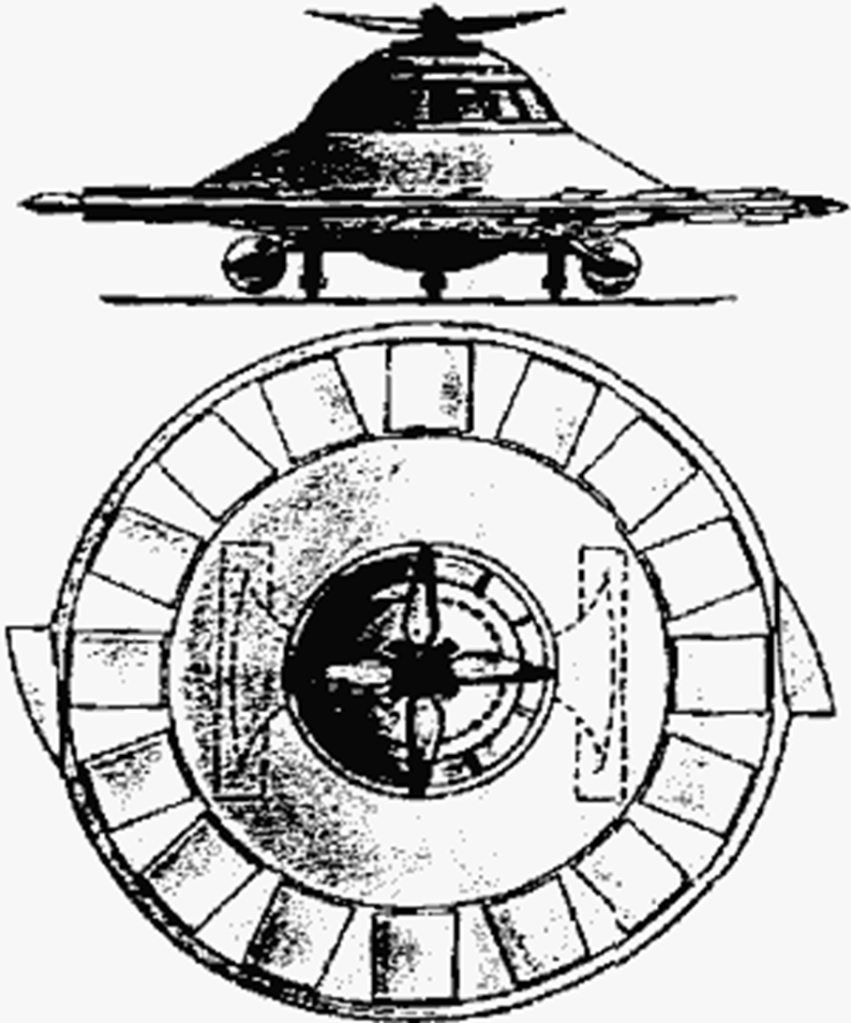
In 1939 Josef Epp, designed his own radial rotor/jet power craft, which he “Helioplane.” This craft had a classic flying saucer shape, featuring rotor veins which contained jet engines for lift, and a small propeller on top of the cabin for directional control. Since other companies were fighting for these engines, Epp went to work trying to develop a new type of disk craft, with a more original type of propulsion. Epp worked on his own design until he heard about BMW’s Flugerad project, which was a flying saucer that use BMW 003 series jet engines, to trust forward using jet pipe, while the same jet engine ran a giant set of rotor blades that were inside the body of the aircraft. Josef Andreas Epp visited Prague, to see BMW flying saucer work for himself.

 UFOs are From
Leave a comment