Arthur Sack was originally a farmer, who would later take on a new passion for designing and building airplanes.
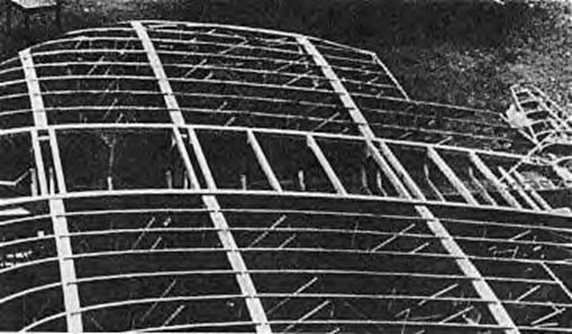
In 1939 Arthur Sack attended a nation contest for aero plane designs and model building, in Leipzig-Mockau. His first entry was a circular winged craft, known as the AS-1. His first circular aircraft was small and powered by Kratmo-30 motor. His first plane entered into the competition could barely get off the ground. The AS-1 needed another aircraft to assist it during takeoff, since it couldn’t even get off the ground, by itself. After it was off the ground, AS-1 only managed to travel 100 meters, before crashing into the ground.
Even though it did not fly well, it did attract the attention of Air Minister General Udet. Fascinated by the circular shape of the craft, he went ahead and offered his backing, into helping back Sack’s research and prototyping. Right ahead, they went on to work on multiple other designs and concepts of these types of vehicles, known as the “A.S.” series. All of these were unpiloted scale models of these crafts. With the AS-5 being the largest test model, and the soundest design.
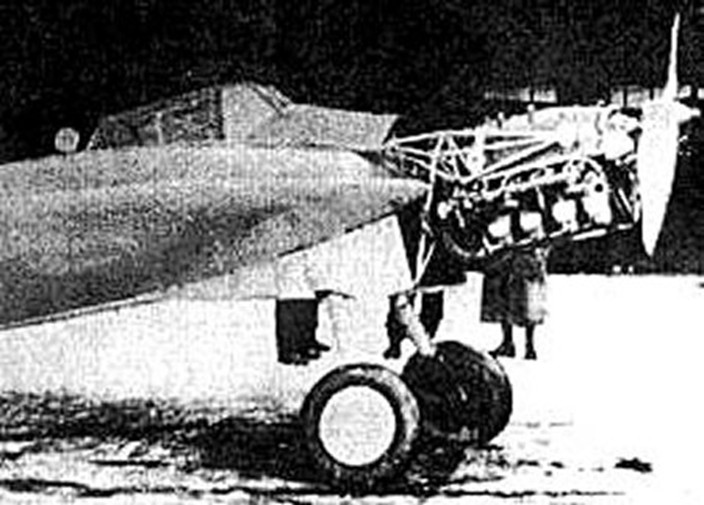
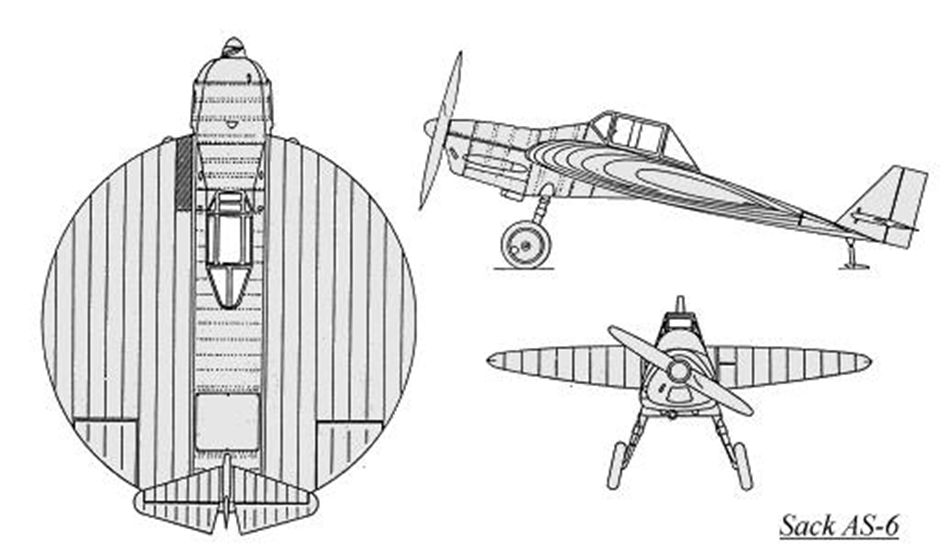
In January 1944, at an air base at Leipzig, Sack and his team were going to take to the skies, which was going to be manned; named A.S.V-1. This craft was built using the workshop of the Mitteldeutsche Motorwerke company, and was test flown at Brandis Air Base, a month later. The main construction of the aircraft featured mainly plywood, for the body, while parts for the landing gears and cockpit were taken from a wrecked Messerschmitt Bf 108 Taifun. The engine was from an Argus AS 10C-3, which was capable of producing 240 horsepower, which turned two wooden propellers.
The February of 1944, the AS-6V-1 did it’s first taxi test by pilot Baltabol, from the ATG/DFW of Leipzig. During this taxis test, it was found that the rudder wasn’t strong enough, which resulted in the crafts losing agility, which resulted in a minor crash. After the rudder was fixed, another series of tests of separate take-off took place, on a 1,200-meter runway at Brandis airport. They found out the control surfaces failed, causing the vacuum on the top part of the wing to not form properly. This ultimately led to a crash landing, on the fifth test, where the right landing gear was destroyed.
It was clear to the team that a more powerful engine would be needed to power this style of vehicle, but due to war restrictions. It was also proposed that the landing gear was also moved back 20 cm, to aid in a more stable landing. However, this would require reconstruction of the whole craft. Instead, a more powerful braking system, from a Junker Ju-88 was installed, and 70 kg of ballast was added to the craft. There was also a longer tail that was added as well.
The third test flight of Aurthur Sack’s system took place April 16, 1944, at Brandis airport. During this test flight, the craft was tested on a shorter 700-meter runway, where it could not get airborne, besides a few hops.

There was a fourth test, where the craft was able to hop even more, but torsion, generated by the propeller caused the craft to bank left, causing it to crash. It was then learned that the small wing area, along with the short design made this aircraft very unstable. While these same concepts would be proven later, Baltabol the test pilot, lost all hope. He did, however, put together more recommendations for Sack’s team including installing the same type of Daimler-Benz engine used on the BF-109, and to also spending more time doing wind tunnel test as well. Sack went on to study these problems and alter his design accordingly. Sack worked on his design.

The design was almost scrapped if it wasn’t for a fresh group of pilots from Group I/JG400, who were experienced Me-163 Komet pilots. These pilots had much more experience with difficult landings and takeoffs, compared to Baltabol. A new pilot from the group was picked for testing Sack’s craft, named Oberleutnant Franz Roszle. The more experienced pilot was only able to get a few hops out of the craft before the vehicle collapsed its own landing gear.
 UFOs are From
Leave a comment