In 1937 the British Interplanetary Society’s started designing a type of Spaceship that would take the British empire to the moon. Two years later their findings were published. Originally the plan called for multiple solid fueled rockets attached together, until it was redesigned to run off of liquid fuel in 1947, after the V2 were discovered.
After Germany started developing the Magdeburg to test lunar launch systems. The British Interplanetary Society’s (BIS) would follow suit, with being the second country to dedicate resources and time to landing on the moon in 1938. However, England had no experience with liquid fueled rocketry at the time and were only familiar with using solid fuel rocket engines. This is what they had to design their lunar mission with. The launch vehicle was going to utilize “infinite staging,” where 2,490 rocket engines would be stacked on top of each other, with burn engines falling off as they were exhausted.
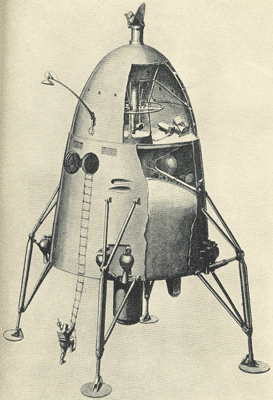
This would then take a capsule, similar to an Appollo lander, and land 3 astronauts to the moon. It would use the same type of landing gear as Apollo had. Once they were done on the moon, the astronauts would launch the moon in the lander. The lander itself would enter the earth’s atmosphere and parachute down to earth.
The biggest problem that the British noticed in their design was how difficult it was going to be to steer the ship. Even though this flight plan was much simpler than Apollo’s, it still required a large amount of maneuverability, that a solid fuel rocket wouldn’t have.
The original design needed 2,490 smaller rockets, thus providing something similar to an infinite booster system. All stacked up, the main rocket would measure 32 meters and 6 meters wide. The craft was intended to be launched at space port at a flooded caisson in a high-altitude lake near the equator. After launch the space craft would carry 3 men to the moon, utilizing apollo style landing gears for touch down. Using the same solid fuel rocketry, to launch back to earth, where a parachute would be deployed during entry into earth’s atmosphere, to slow the craft down for landing.
Later after World War Two was over, and liquid fueled rocket technologies were in the allies’ hands, BIS started working on their own liquid fuel design of a lunar lander, in 1948. This new design featured a refueling system much like the air force used in midair refueling, to reach the moon. This would require 3 rockets needing to be launched for the mission.
The plan was redesigned to use liquid fuel rockets instead of solid fuel rockets. It was estimated that to get a 1 metric ton spacecraft to the moon, the rocket would require 1000 metric tons of fuel.
The new design was very considerate of the fact that a liquid fueled rocket would need to be jettisoned as well, during flight. The plan was to attach petrol cans to the craft and have them fall off as each can emptied during flight, unlike the current staging system that we are all familiar with.
Interestingly enough the scientist didn’t see any problems with overheating the craft during re-entry, but feared that their craft over heating during accent, due to air friction, was a much bigger problem. Later practical launches would say otherwise. Because of the BIS-Lunar Lander was designed with no heat shielding where it mattered, underneath the capsule, but there was a ceramic heat shielding placed at the front end of the rocket, which would be jettisoned off after the accession into space.
The nature of the rocket was still yet to be designed. The scientist predicted that they would need 100,000 hp to launch the craft. This would be done using multiple motors to launch the craft from the beginning, and then during the launch engines would jettison off the craft to make it lighter, when it required less power. Early designs of the liquid fueled rocket variant had designs for smaller liquid fueled rockets to be fired and jettison off. Unlike the modern system with the use 2-4 large stage, the BIS system required hundreds of smaller systems, as compared to a few large ones.
When the craft would launch, the outer rockets would be ignited first and then the inner rocket would be ignited as the outer rockets burnt up. At which point the thrust from the internal rocket would jettison the spent outer rockets, after release bolts were set off.
The spaceship was intended to be navigated by controlling which motors and how many were fired off at any given time. So, to steer the BIS ship would ignite more rockets on one side. There was also a concept introduced where the main trust would be produced by a solid fuel rocket motor, and the steering would be done with small liquid fueled rockets, which could be controlled more easily. Another invention for steering was to use steam jets, much like a modern spaceship uses.
The tip of the ship would contain a spacecraft that would act as space vessel. It would be equipped with an air lock, air control, storage, living quarters, and cockpit would be located. Below this would be all the smaller rockets needed to launch the craft. These would take up most of the craft and be organized in hexagonal tubes. None of the life support systems or other controls were designed yet, this made designing the spacecraft inaccurate and resulted in a vehicle being designed that would be too small.
In space the ship would rotate and turn to produce artificial gravity by centripetal force. At the time, no one on earth knew what the long-term effects of zero-gravity were, so this was done as a precaution.
While the British never made it to the moon, they were definitely looking at ways to grow their empire. The British had the largest empire due to their Navy. It seems at a time the crown wanted to be more than just earth bound.
 UFOs are From
Leave a comment