The V2 was first space ferrying rocket, while the V2 is a part of another series of rockets known as the Aggregrat 4 or A4 for short. The Germans did make and test smaller vehicles leading up to the A4 design. They also came up with other designs for vehicles, which would never be built or tested, but would lay out theories as to how space vehicles could be made. These futuristic designs only started to appear once Saenger joined the Rocket Society at Peenemunde.
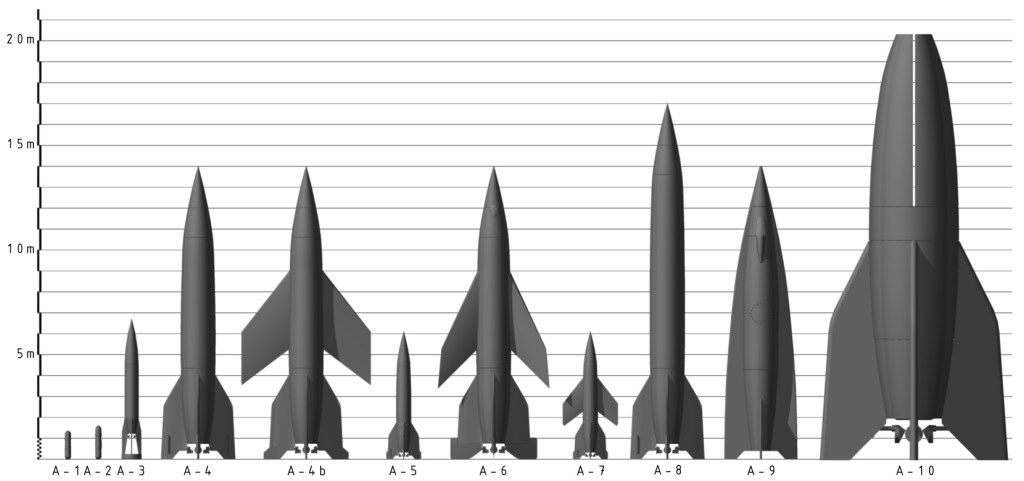
A6
The first manned design of a V2 was something known as the A6. This was a combination of a V2 rocket engine, accompanied by a ramjet. It was built to be a uninterceptable reconnaissance craft thanks to its speed, just like the Sr-71 was capable of doing, thirty years later. The A6 would be launched vertically like a V2 to an altitude of 60 miles. After the rocket engines would cut out, the rocket would begin a supersonic glide, back to earth. During this phase of the flight, the ramjet would be ignited on, which would provide an estimated fifteen to twenty minutes of powered flight. Once the mission was complete the A-6 would use a parachute, to slow down, in order to execute a conventional landing.
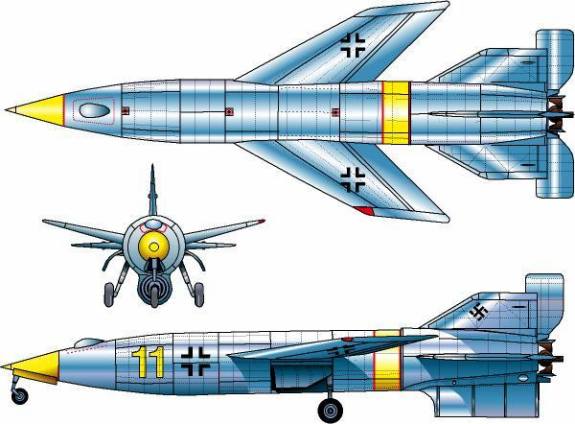
A7
A7 was a planned rocket that was smaller and was designed for use by the Kriegsmarine. It utilized hardware from the A5 series of rockets and had swept back wings as well to increase its range. Two drop tests of this design of rocket were completed successfully, which inspired two prototypes of the V2 with the same sweptback wing design, known as an A4-B.
A8
This rocket was a stretched version of the V2 which was designed to carry more fuel. This design also featured rocket engines that would use other fuels beside alcohol, such as nitric acid or kerosene.
A9/A10…
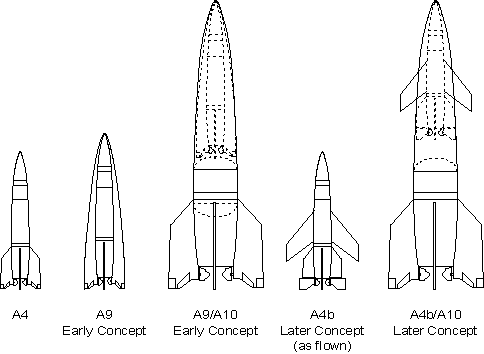
The A9 was another manned version of the V2, which had no ramjet, or other means of propulsion besides its main racket engine. This rocket would also feature an upgraded engine as compared to previous models before it. The A9 was also able to be staged with an A10 underneath it. The A10 was a much bigger rocket with a much larger engine. This would make the A9/A10 the first theoretical design for a 2 staged manned rocket. There were other variations of this design as well such as a three-stage A9/A10/A11, or a four-stage A9/A10/A11/A12.

Von Braun orbital launcher as first sketched out for the US Army, 1946.
There were actually two designs of A9. The first version had a leading-edge wing on it which matched the profile of a V2. The second design featured a swept back wing design like the A6 or A7.
It’s incredible to look at these designs, and wonder how space travel could have been different, if World War Two, never happened.
 UFOs are From
Leave a comment