While Aggregats aren’t UFOs, but rather a series of rockets, it’s still interesting to study their developments, to see just how far, this other form of space developed, under the Germans, before being taken over by the Soviets and Americans.
A1
One of the most famous rocket pioneers, joined Germany’s rocket program in fall of 1932. He studied aviation at college and was seen as much brighter than people in the Rocket Society. When Von Braun joined the rocket society the men there were mainly testing Miraks, which where like a liquid fueled version of a bottle rocket, and the slightly lager HW-2 and HW-2. These rockets had bottom mounted motors, much like a typical rocket, but were small and simple. Von Braun was going to scale up this operation for the next 7 years.
He even brought with him his own homemade rocket engine. It didn’t work, but it still proved to everyone how bright he was. He learned that the engine overheated too quickly so he made another test engine, built inside a fuel tank, which made use of the fuel as a coolant. It worked!
This new style of engine was going to be built and installed on a new type of rocket known as an Aggregat, with the first model being called Aggregat 1 or A1 for short. It had a gyroscope in the nose to help stabilize it made by Kreiselgeräte GmbH, and pressurized air tank full of nitrogen to supply the fuel. It measured in at only around 4 feet long. Unfortunately A1 failed, after too much propellant built up in the combustion chamber before the ignition, which caused the whole thing to blow up.
A2
Undeterred the rocket team went to work building their next protype of a similar system. These would be known as A2 or Aggregat 2. This time two of them would be built, with names taken from Katzenjammer, “Max” and “Mortis.” Not much was different between A1 and A2, besides the fuel feeding system was fixed, and the gyroscope was moved to the middle of the rocket, making the new craft slightly longer.
Both of them were launched a year after the A1 failure, with both of these rockets working as a success.
A3
The next step was to scale up A2, under the name A3. This also meant that the program had to have its hardware scaled up too. This rocket was going to be 22 feet tall, compared to 4 feet, from its previous prototypes. Two bigger launch platforms were built, as well as another rocket engine locomotive. They also were given a bigger base to test this out as well at, known as Peenemünde. The government also helped provide more industrial support for A3.
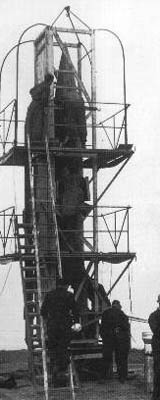
While it took a few years to build a rocket the size of A3, it wasn’t the most aerodynamic rocket, with its round nose. While building A3 was under way, a new style of pointed rocket was tested in a wind tunnel. This model of rocket was even tested in the world’s first supersonic wind tunnel. However development was already underway, and it was too late to change the body design for aerodynamics of A3. There were also designs for a much larger rocket as well, for something the size of the V2.
After three years, the four A3 Aggregat rockets were ready for testing, in December 1937. All four of these tests ended in failure.
A4
In the meantime, the engine for the A4 was being built and was tested the following year in January 1938. It took a year and a half to build this engine. After over a year of testing the larger A4 engines were ready for flight. The only problem was that the Germans did have a rocket body which they felt was aerodynamic enough.
A5
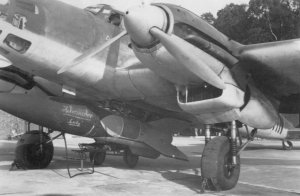
In the spring, another rocket was dropped tested, known as the A5. This rocket was the same size as the A3 and had the same engine, the mane difference was the shape of the body. These rockets had a famous pointed nose design which is akin to the famous V2 designs that were seen later on in the war. The A5 was also the first rocket to be put into mass production with 25 being built, with 80 launches. Many of these A5 were used in drop tests, with some having propellors instead of rocket engines on them.
March 23rd of 1939 Hitler visit the rocket society. The scientists showed off many of their creations including an A3 with a cut away view. During the visit two different size rocket engines were ground tested. Hitler seemed to be quiet the whole time. Only asking two questions, 1 about the potential range of these devices, and about utilizing synthetic materials like Eisenbled, in replace of lighter alloys needed for the aircraft industry. Hitler also knew one of the earlier rocketeers: Max Valier, when he lived in Munich. Hitler made mention on how he dismissed Valier as a dreamer but was impressed to see how this area of study developed over the last few years.
When Hitler left, many of the rocketeers felt like his industrial focus, was still on planes, tanks, artillery, naval assets, and not rocketry. For a while the development of German rocketry hung in the balance, from need more funding to work or utilize the funds and base for other war pressing needs. Luckily in September the rocket port had another visitor: Herman Goering. His impression of rocketry was much different than that of Hitler’s and saw a great potential for their use. Rocketry was given the highest priority, with 4,000 soldiers with technical backgrounds being pulled from other military units to support this project.
Germany was going to build liquid fueled rockets for the war.
Source: V-2
 UFOs are From
Leave a comment