Another person inspired by Frau im Mond” (Woman in the Moon), would be Hermann Noordung, from neighboring Austria. During Worl War One, and rose to the rank of Captain, before falling ill with tuberculosis, which he got in the army. Due to his illness, we were sent back to Germany. This gave him a chance to learn about electrical and mechanical engineering. In 1925, Noordung also spent time reading Oberth writings on space flight, and look at it as space travel becoming a military objective, in the book Die Rakete zu den Planetenräume (The Rocket into Interplanetary Space)
Noordung would go onto writing his own book about space travel which he published in 1929, with the name “Das Problem der Befahrung des Weltraums” (The Problem of Reaching Space.) This would have many interesting aspects in it, with topics about creating artificial gravity with a concept known as “Wohnrad” (Living Wheel). This was actually an early concept of a space station that was very similar to what Konstantin Tsiolkovsky proposed earlier.
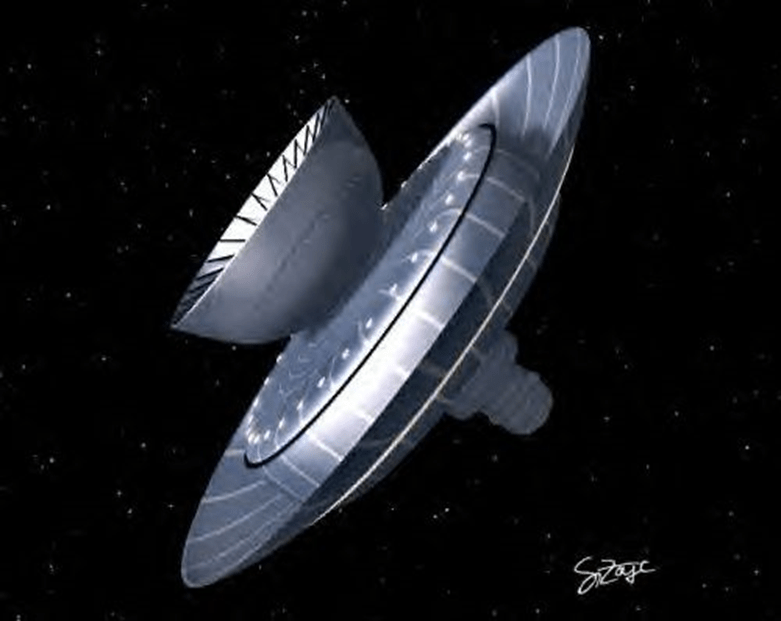
The Wohnrad would be a rotating space station, this way it could use centrifugal forces to create living areas with artificial gravity. His space station was about 164 feet in diameter, and would contain airlocks, bulkheads, living quarters, workshops, labs, a kitchen, and a bathroom. It even had observation ports for people to observe space with.
The space station’s main source of power would be from solar radiation but not using the panels we are used to seeing on space stations, but rather it would have a larger concave mirror which would focus the solar radiation on heat pipes. These heated pipes would produce a hot vapor which would turn a turbine to produce electrical power. The other side of the space station uses shade as a condenser.
Noordung’s work was viewed as a refinement of Oberth previous study, and view to have great promise. Unfortunately, Noordung died shortly after, from pneumonia, but the legacy of his work would continue to inspire others, with it being translated into different languages. His works would most notably go on to continue to inspire Oberth and von Braun to develop their own ideas about space travel even further.
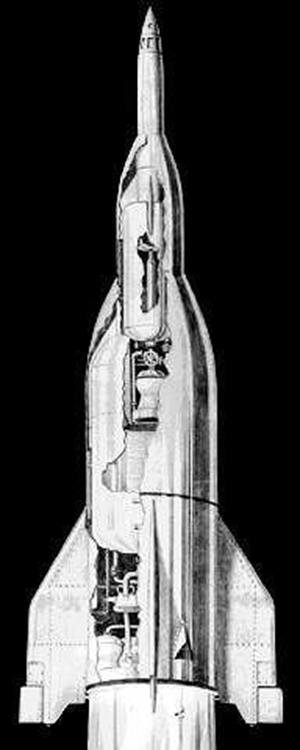
If Noordung hadn’t died in 1929, he could have had more prominent role in German weapons development, with the Anschluss and the unification of Austria with Germany. There’s no doubt that we would have more developments space bearing technologies such as multistage V2 rockets, such as A9/A10, and space stations if Noordung was alive and able to get involve in German Rocket Society. Even the idea of the Germans launching a giant mirror into space known as the Sonnenlinse. Von Braun even worked on designs for a triple sage V2 rocket known as the A11, which would be equipped to transport the Germans giant space mirror satellite into orbit.
Unfortunately, the German’s space project was captured by the allies at the end of World War II. Oberth and von Braun were captured and sent to work making rockets for America after the end of World War 2, under project paper clip where they kept on developing Noordung’s research even further.
The projected A-11 three stage
satellite launcher
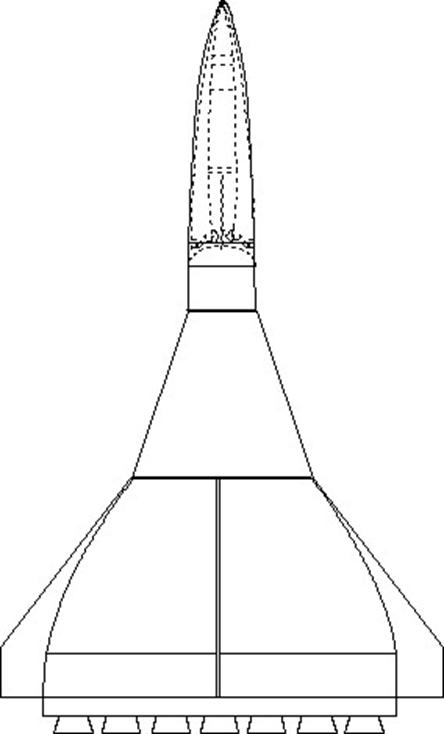
A-9/A-10/A-11
Illustration by von Braun, Fort Bliss 1946
Artist impression of Wohnrad with space mirrors deployed
 UFOs are From
Leave a comment