Under the treaty of Versailles, many Germans had to look for other means, to try and retake back their country. This new treaty limited the amounts and types of weapons that Germany could produce. With the limitations placed by the Versailles treaty, cannons and conventional field artillery became banned. Many people inside Germany spent time looking for ways around this problem, with many of their scientist spending time studying rocketry, in hope of recreating another weapon, with the similar impacts of artillery.
But artillery wasn’t the only use the Germans had for rockets. The invention of the liquid fueled rocket also provided the backbone for space travel. To fuel interest in the idea of space travel, and the propulsion needed Hermann Oberth wrote “The Rocket into Interplanetary Space.” While Opel might have tested out rockets on many of his stunt vehicles, Oberth was the one who really put the science together on space travel. This new field of study and book would go on to influence Werner Von Braun, who helped build the American Apollo program.
On June 5th of 1927, the first meeting for The Society of Space Travel took place. While the initial meeting only had three attendees, it would grow by past 500 within its first year. These interwar meetings contained many members who would later be pioneers of space travel. They even caught the eye of famous German film director by the name of Fritz Lang. Who reached out to the society to study the potential field so he could create a movie about space travel to the moons, called The Girl in the Moon. Frit also offered Hermann Oberth to build a liquid fueled rocket in order to promote the new film. Two rockets were built but never flew in time for the film. The film studio took ownership of the two rockets since they funded the project originally.
A few months later the rocket society sought to bring back materials for the rockets and have then try to fly them. However, upon retrieval it was discovered that Oberth’s rockets were too complex to fly anyway. Instead, the team decided to start the project from ground up with “Mirak.” This was a very simple version on a liquid fueled rocket, like the one Robert Goddar launch back in 1926, in America. By April 30th, 1930, the German were showing off the newly built contraptions and giving lectures on what they had built, in hopes that it would fly. In July the rocket society continued perfecting the motor for Mirak on a small farm. The Mirak was a rocket, design to pull itself like a bottle rocket.
After a few tests, their rocket motor exploded, maybe on purpose. Because in late 1930 the rocket society rented a bigger lot for $4 dollars, a year, at an old artillery range. They had access to old munition storage facilities as well as numerous bunkers. It also had a 10 sq. kilometer area for artillery practice, back when the site was a military base. This was the first rocket port. The Rocket society was also given an allowance of 5,000 Reichsmarks. The new base, Kummersdorf, had a military officer named seeing their rocket developments as a missile program. This man was respected and at the time was an army Ordnance Office.
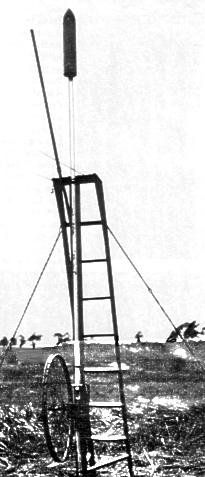
More and more tests with the small Mirak took place. With fuel tanks becoming standardized, with different motors being designed and tested. The Mirak rocket showed much promise as a weapon. In October of 1931 the rocket scientist was treated like celebrities, during a new reel, which showed off their work to the German population. What was once mere science fiction had turned to reality, by then 270 engine test runs had been completed, as well as 87 test flights. However, one of the rockets misfired and flew into a police shack, which was caught on film. The shack caught on fire. This did get restrictions put on the group working in that area, but they continued their designs and flights.
It became clear that liquid fuel rockets could be used as a long-range weapon. HW-1 and HW-2 were the next rocket series to be test after Mirak 1, 2, 3, & 4. HW-1 was a small engine much similar to the same style of a Mirak, but the engine produced a bottom flame meant for pushing, as seen on modern rockets, unlike a bottle rocket. It was also much larger and considered to be a monster for its day. It was 6 feet tall. Unfortunately, it failed after 3 meters of flight, then exploding.
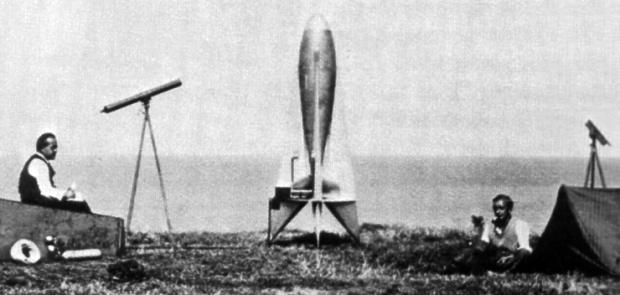
Luckily a new person, just joined the rockers team… Wernher von Braun. Germany was also receiving a new leader as well, who would take his country in a much similar direction like von Braun did with rocketry.
 UFOs are From
Leave a comment